Most candle makers price by looking at what other shops charge, then knocking a couple of dollars off. It feels safe, but it hides a problem: you don't know whether a $22 candle earns you $12 or $2. Below is the method we use in our own calculators. It works for jar candles, tins and pillars, in ounces or grams. We'll go through one candle from raw materials to a retail and wholesale price.
The candle pricing formula in one line
Price = (materials + labor + overhead) × markup, then check it against fees and the market.
Each part matters:
- Materials is everything that ends up in or on the candle: wax, fragrance oil, wick, vessel, lid, dye, warning label, box or tissue.
- Labor is your time, paid at a real hourly rate. If you skip it, you have a hobby that buys its own supplies, not a business.
- Overhead is the monthly cost of running the shop (software, test burns, scales, insurance, Etsy listing renewals, market stall fees), spread over the candles you sell.
- Markup covers the profit itself, slow months and the discounts you'll give to wholesale buyers.
Then you check two things: what the marketplace takes in fees, and whether buyers in your niche will pay that price.
Step 1: Work out the cost per ounce (or gram) of each material
Suppliers sell wax by the 10 lb bag and fragrance by the 16 oz bottle, and they add shipping. Always include the shipping. It's a real cost per ounce, and on small orders it can add 20–30%.
Cost per unit = (pack price + shipping) ÷ pack size
Our example supplies:
| Material | Pack | Price + shipping | Cost per unit |
|---|---|---|---|
| Soy wax | 10 lb (160 oz) | $32 + $8 = $40 | $0.25 per oz |
| Fragrance oil | 16 oz | $28 + $4 = $32 | $2.00 per oz |
| Cotton wick (pre-tabbed) | 100 | $0.15 each | |
| 8 oz amber jar + lid | case | $1.45 each | |
| Warning/brand label | roll | $0.20 each | |
| Box and tissue | pack | $0.60 each |
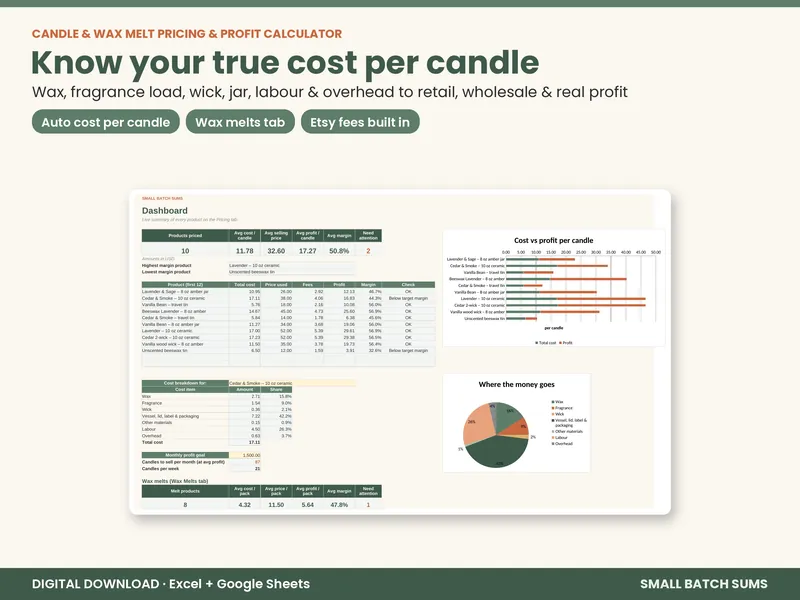
If your supplier sells in kilograms or pounds and you pour in grams or ounces, convert once: 1 lb = 16 oz = 453.6 g, and 1 oz = 28.35 g. Our Candle & Wax Melt Pricing Calculator does this conversion for you. You type the pack size in whatever unit is on the invoice.
Step 2: Cost of one candle (materials)
An "8 oz" jar rarely holds 8 oz of wax. Weigh what you actually pour. In our example the fill is 7 oz of wax at an 8% fragrance load.
- Wax: 7 oz × $0.25 = $1.75
- Fragrance: 7 oz × 8% = 0.56 oz × $2.00 = $1.12
- Wick $0.15, jar and lid $1.45, label $0.20, box $0.60
Materials per candle: $5.27
Two things to notice. First, the jar costs almost as much as the wax and fragrance together, so changing the vessel moves your price more than switching wax brands. Second, fragrance load matters: at 10% instead of 8% the fragrance cost rises to $1.40. Calculate fragrance as a percentage of the wax weight. This is the most common way to measure it, and it's the one our calculator uses. Some makers measure it against the total weight instead, so be consistent.
Step 3: Add labor at a real hourly rate
Time a whole batch, not one candle: prepping jars, melting, pouring, topping off, curing checks, labelling, packing. Then divide by the number of candles.
Say a batch of 20 candles takes 2 hours. That's 6 minutes per candle. At $18/hour:
6 ÷ 60 × $18 = $1.80 labor per candle
Choose your rate on purpose. $18/h is a modest wage in the US or UK. If you pay yourself $0, every price you calculate is too low the day you want to grow, hire help or take a week off.
Step 4: Spread your overhead
Add up the monthly costs that don't belong to a single candle: say $75 a month for software, test-burn candles, Etsy listing renewals and a share of your equipment. If you sell about 120 candles a month:
$75 ÷ 120 = $0.63 per candle (rounded)
Total cost per candle = $5.27 + $1.80 + $0.63 = $7.70
That is your true break-even. Below $7.70 you lose money on every sale, even if it doesn't feel like it.
Step 5: Apply a markup and round to a clean price
A common starting point for handmade candles sold direct is a markup of 3× total cost (some makers use 2.5×, luxury brands 4× or more).
$7.70 × 3 = $23.09, rounded up to $24.
Always round up, not to the nearest dollar. Rounding up makes sure the markup is never undercut, and clean prices like $24 or $26 read better on a market table than $23.09.
Step 6: Check what fees leave you
On Etsy, a typical order pays the $0.20 listing fee, a 6.5% transaction fee, and payment processing (in the US 3% + $0.25). Rounded together, that's roughly 9.5% + $0.45 per order. (Etsy also charges the transaction fee on the shipping you charge, plus Offsite Ads fees on some sales. Check your country's current rates.)
- Fees at $24: 9.5% × $24 + $0.45 = $2.73
- Profit: $24 − $7.70 − $2.73 = $13.58 (with the unrounded cost of $7.695)
- Margin: $13.58 ÷ $24 = 57%
And that is after you paid yourself for your time (the $1.80 labor is already inside the $7.70). A healthy number.
Now compare a "copy the competition" price. At $18 the same candle leaves $8.14, and at $22 it leaves $11.77. Neither is a disaster, but you now know exactly what each dollar of discount costs you.
Step 7: Wholesale is where thin margins hide
Shops usually expect to buy at 50% of retail so they can double it. At $24 retail that means $12 wholesale:
- Wholesale profit: $12 − $7.70 = $4.31 (36% margin, no marketplace fees)
$4.31 per candle can still be worth it: a 48-candle order is $207 of profit in one invoice, with no packing for individual customers. But it shows why a 2× markup doesn't work if you ever want to sell wholesale. Half of a 2× price is your cost, so you'd make nothing. If you plan to wholesale, set your retail price so that 50% of it still clears your total cost with room to spare.
Step 8: Sanity-check against the market (not the other way round)
Only now look at competitors. Search your niche on Etsy and at local markets and note what similar candles sell for. If your calculated price is far above the market:
- Lower the cost, not the markup. A cheaper vessel, buying wax in bigger bags, or pouring larger batches (less labor per candle) all help.
- Raise the perceived value. Better photos, a gift-ready box, a scent story, a reusable vessel.
- Drop the product. Some candles just don't work at a price buyers accept. That's useful to know before you make 100 of them.
If your price is far below the market, good news: you can probably charge more.
Common candle pricing mistakes
- Forgetting shipping on supplies. $8 of shipping on a $32 bag of wax adds 25% to your wax cost.
- Using the jar's label size as the wax weight. Weigh your actual pour.
- Not pricing test burns. Testing a new wick takes wax, fragrance and jars too. Include it in overhead.
- Pricing a 4 oz tin as half an 8 oz jar. The labor and packaging are almost the same, so small candles need a higher markup.
- Never revisiting prices. Re-run your numbers whenever a supplier changes prices or Etsy changes its fees.
Wax melts: same method, different units
Wax melts follow the same logic: wax per cavity × cavities, fragrance (often a higher load, 10% or more), the clamshell, and a label. The labor per unit is lower but packaging is a bigger share. Price per pack, then check your multipack discount still clears your cost. The Wax Melts tab in our candle calculator does exactly this.
Want this done for you?
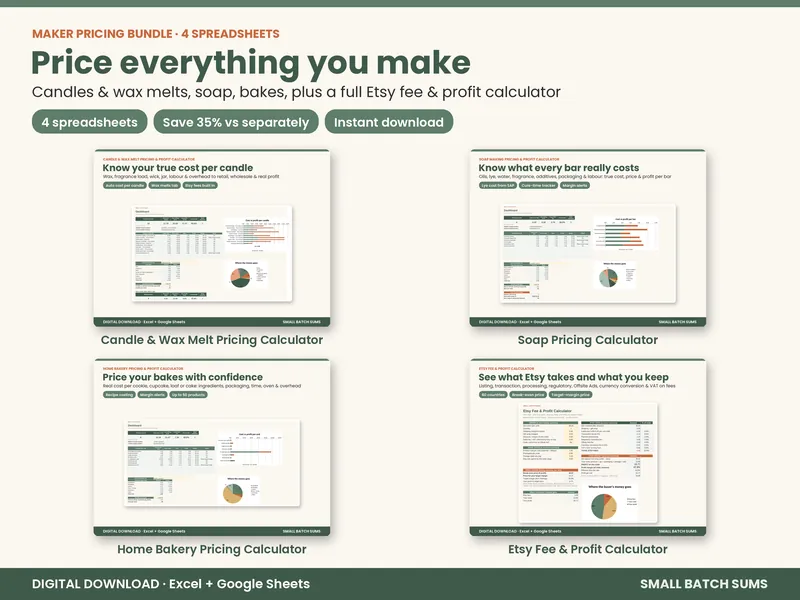
Doing this by hand once is a great exercise. Doing it for 15 scents and three vessel sizes every time a supplier raises prices is not. Our Candle & Wax Melt Pricing & Profit Calculator holds your material list, calculates cost per candle and per wax melt pack, and shows suggested retail and wholesale prices, Etsy fees and real profit. If you also make soap or bake, the Maker Pricing Bundle includes it with our other maker calculators.
Prefer to start free? A one-candle version of this method, the Single Candle Cost Calculator, is coming soon on our free tools page.